
Reduce 5G Radiation at HomePractical Ways to Create a Low-EMF Living Environment
What is 5G and why are more people concerned about it?
The mobile communication standard 5G is the fifth generation of wireless data transmission and enables significantly higher data speeds than earlier technologies such as 4G or 3G.
5G is used for example in:
- mobile internet
- smart home technologies
- connected vehicles
- industrial applications
- Internet of Things (IoT) devices
Like all wireless technologies, data is transmitted through high-frequency electromagnetic fields (EMF).
Depending on the construction of a building, these radio waves can also penetrate indoor spaces.
For this reason, many people want to keep their personal exposure to electromagnetic radiation as low as possible, especially in sensitive areas such as bedrooms or children’s rooms.
How does 5G radiation enter buildings?
Mobile network radiation can reach buildings through several pathways:
- windows
- exterior walls
- roof structures
- poorly shielded building elements
Modern buildings often contain materials such as glass or lightweight façade constructions that allow radio waves to pass through relatively easily.
As a result, mobile radiation can also be measurable inside buildings.
Typical sources of electromagnetic radiation in the home
Mobile phone towers are not the only source of electromagnetic fields. Many households contain numerous wireless devices.
The most common sources include:
- Wi-Fi routers
- Smartphones
- tablets
- smart home devices
- Bluetooth headphones
- cordless phones (DECT)
- smart TVs
- wireless speakers
In modern households, these wireless signals often overlap.
1. Use WiFi and wireless devices consciously
One of the simplest ways to reduce electromagnetic fields is to use wireless technology more consciously.
Practical tips:
- Turn off Wi-Fi at night
- avoid placing routers in the bedroom
- prefer wired internet connections
- activate Bluetooth only when needed
- replace DECT phones with wired phones
These simple steps can already help reduce personal EMF exposure.
2. Create a low-radiation bedroom environment
The sleeping area plays a particularly important role because people spend many hours there.
Building biology guidelines often recommend keeping electromagnetic exposure as low as possible in the bedroom.
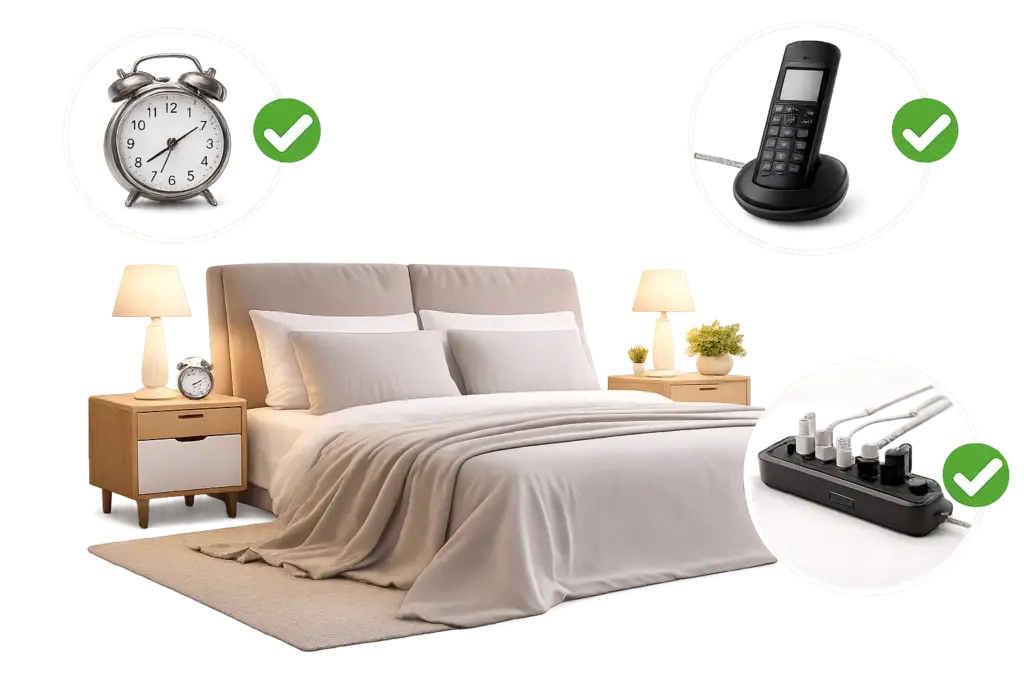
Helpful measures may include:
- avoiding WiFi in the bedroom
- not storing the smartphone directly next to the bed at night
- keeping electrical devices away from the sleeping area
- turning off wireless devices overnight
In some cases, targeted shielding of the sleeping area may also be useful.
3. Measuring electromagnetic radiation
If there is suspicion of elevated wireless radiation levels, a professional measurement may be helpful.
Such measurements are often performed by:
- building biologists
- EMF consultants
- environmental technicians
They measure for example:
- intensity of electromagnetic fields
- dominant frequency ranges
- direction of the radiation source
The results help determine appropriate measures to reduce exposure.
4. Shielding paint against mobile radiation
A proven method for reducing high-frequency radiation is the use of EMF shielding paint.
These paints contain conductive materials such as:
- graphite
- carbon
- metal particles
- modern graphene components
After application, the paint forms a conductive layer that can reflect or attenuate electromagnetic fields.
Shielding paints are often used in:
- bedrooms
- children’s rooms
- home offices
- apartments near mobile phone antennas
The coating can be painted over with regular wall paint, making it visually invisible.
5. Shielding windows
Windows allow radio frequency radiation to pass through relatively easily.
For this reason, additional shielding solutions are sometimes used, such as:
- shielding curtains
- special shielding fabrics
- metallized textiles
These materials can partially reduce radio frequency radiation and are often used in bedrooms.
6. Bed canopies for EMF protection
Another option is a shielding bed canopy.
This is a fine mesh fabric with conductive fibers placed over the bed.
The canopy creates a protected sleeping zone that can reduce electromagnetic fields coming from outside.
Such solutions are often used when complete room shielding is not possible.
7. Exterior shielding of buildings
If strong radiation sources are present nearby, shielding the exterior of the building may also be useful.
For example, special shielding paints can be applied to the façade.
The advantage of this method:
Electromagnetic radiation is reduced before it enters the building.
This solution is commonly used for:
- single-family houses
- apartment buildings
- building biology construction projects
- buildings near mobile network infrastructure
Conclusion
Modern wireless technologies such as 5G are now part of everyday life and enable many useful applications.
However, those who wish to reduce their personal exposure can already achieve a lot with simple measures.
Conscious use of wireless technologies, creating a low-EMF sleeping environment, and targeted shielding solutions can help reduce electromagnetic radiation indoors.
Products such as shielding paints, shielding fabrics, or bed canopies can contribute to creating a calmer and lower-radiation living environment.