
EMF Shielding Paint Against ElectrosmogProtection from mobile networks, Wi-Fi and 5G for homes and buildings
Electromagnetic radiation has become part of everyday life. Mobile networks, Wi-Fi systems, 5G transmitters and many other wireless technologies create an increasingly dense network of electromagnetic fields.
Many people are therefore looking for ways to protect their homes or buildings from electrosmog. One of the most effective solutions is the use of EMF shielding paint.
Shielding paints contain conductive materials such as graphite or graphene that can attenuate or reflect electromagnetic waves. This can significantly reduce exposure to high-frequency electromagnetic radiation.
This guide explains:
- how EMF shielding paint works
- which types of radiation can be shielded
- how strong the shielding effect is
- which shielding paint is suitable for interiors or facades
What is electrosmog?
Electrosmog refers to artificially generated electromagnetic fields produced by electrical devices and wireless technologies.
Typical sources include:
- mobile phone towers
- smartphones
- Wi-Fi routers
- DECT cordless phones
- smart meters
- Bluetooth devices
- high-voltage power lines
Two main types of electromagnetic fields are distinguished.
High-frequency electromagnetic fields (HF)
These are generated by wireless technologies such as:
- mobile networks
- 4G / LTE
- 5G
- Wi-Fi
- radar
- satellite communication
Low-frequency electric fields (LF)
These are produced by:
- household electricity
- electrical wiring
- power outlets
- electrical appliances
A high-quality EMF shielding paint can reduce both types of fields.
How does EMF shielding paint work?
Shielding paint contains electrically conductive pigments, usually:
- graphite
- carbon
- graphene
After drying, these materials create a conductive layer in the wall or on the facade.
This layer can:
- reflect electromagnetic waves
- absorb radiation
- redirect electrical fields
As a result, radiation is significantly reduced before it enters the room.
If the shielding surface is additionally grounded, low-frequency electric fields can be discharged particularly effectively.
What radiation can shielding paint reduce?
A high-quality EMF shielding paint can reduce radiation from:
A high-quality EMF shielding paint can reduce radiation from:
- mobile networks (GSM, UMTS, LTE)
- 5G
- Wi-Fi
- DECT phones
- Bluetooth
- radar
- wireless communication networks
Typical values:
Shielding | Reduction |
|---|---|
30 dB | approx. 99.9% |
40 dB | approx. 99.99% |
60 dB | over 99.9999% |
Applying multiple layers significantly increases the shielding effect.
Shielding paint against 5G
The introduction of 5G mobile networks has intensified the discussion about electrosmog.
5G uses several frequency ranges:
FR1
600 MHz – 6 GHz
FR2
24 GHz – 40 GHz
A good shielding paint should therefore be effective up to at least 40 GHz in order to cover both frequency ranges.
Graphene-based shielding paints are particularly suitable because they can achieve strong shielding even at very high frequencies.
Graphite or graphene – which shielding paint is better?
Most shielding paints are based on graphite.
Graphene is a more advanced form of carbon with extremely high electrical conductivity.
Advantages of graphene in shielding paints:
- higher conductivity
- better shielding performance at high frequencies
- less material required
- more homogeneous coating layer
Shielding paint for interior spaces
Interior spaces can be protected particularly easily with shielding paint.
Typical applications include:
- bedrooms
- children’s rooms
- offices
- apartments
- hotels
- medical practices
Shielding paint is applied like normal wall paint and then painted over with standard interior paint.
Shielding paint for exterior facades
If the radiation source is located outside the building, shielding the exterior facade may also be useful.
Advantages:
- radiation is reduced before it reaches the wall
- several rooms can be protected simultaneously
- ideal near mobile phone towers or strong radio sources
Exterior shielding paints must always be covered with facade paint to protect them from weather conditions.
Application of shielding paint
Application is similar to normal wall paint.
Typical steps:
- Prepare the surface
- Stir the paint thoroughly
- Apply the first coat
- Allow it to dry
- Apply the second coat
For reliable shielding, at least two coats are recommended.
How strong is the shielding effect?
Shielding performance is measured in laboratory tests.
High-quality shielding paints typically achieve:
- approx. 35–40 dB with one coat
- approx. 55–65 dB with two coats
However, the real effectiveness also depends on:
- number of layers
- substrate
- grounding
- windows
Choosing the right shielding paint
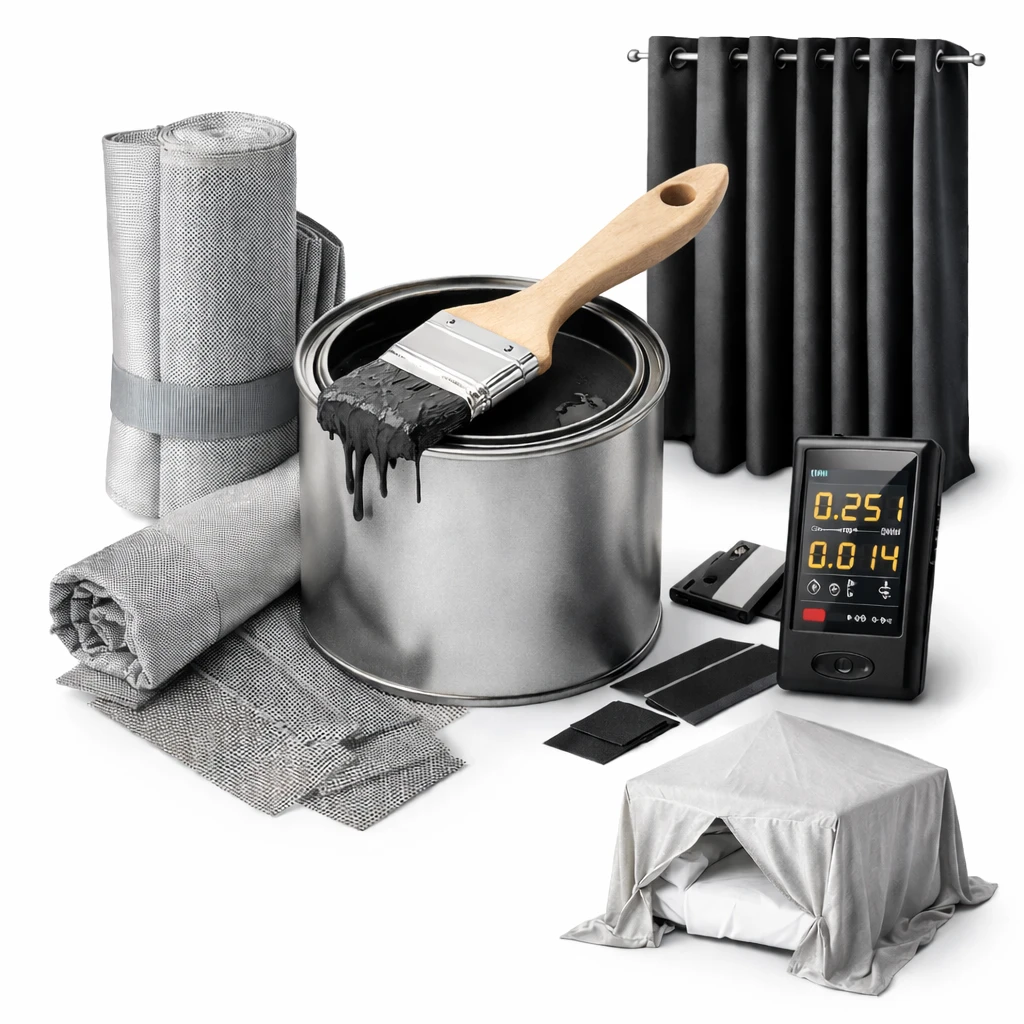
Several factors play a role when selecting shielding paint:
- interior or exterior use
- desired shielding performance
- ease of application
- ecological properties
- storage life
Our shielding paint is supplied as a powder that is mixed with water shortly before use.
Advantages:
In our product range, you’ll find high-quality shielding paints for various applications:
- long shelf life
- frost-resistant shipping
- reduced transport weight
Professional shielding paints
Our range includes high-quality shielding paints for various applications.
Shielding paint for interiors
- Shield Interior Performance (graphene)
- Shield Interior Classic (without graphene)
Shielding paint for facades
- Shield Exterior Performance (graphene)
- Shield Exterior Classic (without graphene)
These products were developed for:
- residential buildings
- offices
- hotels
- sensitive sleeping areas
- architectural projects
Conclusion
EMF shielding paint is one of the most effective ways to protect buildings from electromagnetic radiation and electrosmog.
Modern materials such as graphite and graphene make it possible to achieve very high shielding values without altering the appearance of interiors or facades.
When applied correctly, shielding paint can significantly reduce exposure to mobile networks, Wi-Fi and 5G radiation.
Tip
For optimal shielding:
- apply at least two coats of shielding paint
- ensure proper grounding of the shielding surface
- take windows and openings into account